
Gut Bacteria, Belly Fat, Thyroid & Mood — The Connection Nobody Told You. Your gut bacteria control far more than digestion. Learn how gut microbiome imbalance drives belly fat, thyroid problems, PCOS, mood swings & inflammation — and what root-cause testing reveals.
A 41-year-old banking professional from Chennai walked into his gastroenterologist’s clinic with a simple complaint: bloating after every meal. Had been happening for over a year. Getting worse, not better.
The doctor ran an endoscopy. Normal. Ultrasound. Normal. Basic blood work. Normal. Diagnosis: “Probably IBS. Take this antacid, avoid spicy food, eat more fibre.”
He followed the advice for six months. The bloating continued. But that was not the interesting part.
The interesting part was what else was happening during those six months that neither he nor his gastroenterologist connected to his gut: he gained 7 kg — almost entirely around his belly. His fasting blood sugar crept from 95 to 112. His energy levels fell off a cliff. He started sleeping poorly. And for the first time in his life, he began experiencing low-grade anxiety that he could not explain.
He went to different doctors for each of these problems. An endocrinologist for the blood sugar. A general physician for fatigue. Even a psychiatrist for the anxiety. Nobody — not a single one — asked about his gut.
Because in conventional Indian medicine, the gut is a digestive organ. You eat food, it processes the food, it sends the waste out. That is it. End of story.
Except that is not even close to the real story. Not even remotely.
Your Gut Is Not a Food Processor. It Is a Command Centre.
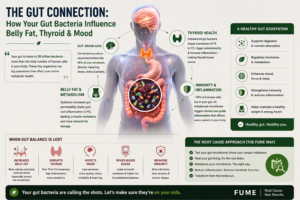
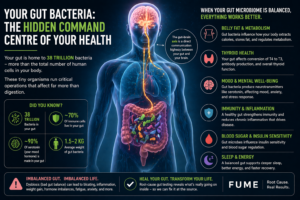
Here is a number that should stop you in your tracks: your gut contains roughly 38 trillion bacteria. That is more bacteria than the total number of human cells in your entire body. You are, quite literally, more bacteria than human.
These 38 trillion bacteria are not freeloaders. They are not just sitting in your intestines waiting for food to pass through. They are actively running critical operations in your body — operations that have almost nothing to do with digestion.
Your gut bacteria manufacture hormones. They produce neurotransmitters — including about 90% of your body’s serotonin, which directly controls your mood. They regulate your immune system — roughly 70% of your immune cells live in your gut. They influence how much fat your body stores, where it stores it, and how easily you can burn it. They communicate directly with your brain through the vagus nerve in what scientists call the gut-brain axis. They affect your thyroid hormone conversion. They influence your insulin sensitivity.
Read that list again. Hormones. Mood. Immunity. Fat storage. Brain function. Thyroid. Insulin.
Now tell me — does it make any sense that mainstream medicine treats the gut as just a digestion pipe?
This is why at FUME, gut microbiome analysis is one of the 8 core pillars of our Bio-Intelligence System. Because you cannot claim to understand someone’s metabolic health if you have not looked at the 38 trillion organisms that are quietly running the show.
The Gut-Belly Fat Connection: Why You Cannot Out-Diet a Broken Gut
Let me start with the one that bothers most people the most. Belly fat.
You have tried calorie deficit diets. You have tried cutting carbs. You have tried intermittent fasting. You have tried morning walks, gym, yoga, and everything your cousin’s friend recommended on WhatsApp. And the belly fat stays. It might shift temporarily — a kilo here, two kilos there — but it comes right back, and it comes back around the middle.
Here is something your dietitian probably never told you: your gut bacteria directly influence how your body stores fat.
There are specific bacterial populations in your gut — broadly categorised as Firmicutes and Bacteroidetes — whose ratio significantly affects your body’s tendency to extract and store calories from food. Research consistently shows that people with excess belly fat tend to have a higher ratio of Firmicutes to Bacteroidetes. Their gut bacteria are literally more efficient at squeezing calories out of the same food and storing them as fat.
This means two people can eat the exact same meal, and one person’s gut bacteria will extract and store significantly more calories from it than the other’s. The person gaining weight is not eating more. Their bacteria are harvesting more.
But it gets worse. An imbalanced gut microbiome also drives chronic low-grade inflammation. And inflammation — specifically a marker called lipopolysaccharide (LPS) that leaks from the gut into the bloodstream when the gut lining is compromised — triggers your body to increase fat storage around the abdomen specifically. It is not random that stressed, inflamed bodies store fat around the belly. Visceral fat — the dangerous fat surrounding your organs — is an inflammatory fat storage pattern. And the inflammation often starts in the gut.
So when you are struggling with belly fat that will not budge despite “doing everything right” — the problem may not be what you are eating. The problem may be who is eating it. And by “who,” I mean the trillions of bacteria that process your food before your body even gets to it.
A 36-year-old project manager from Bangalore had been trying to lose her post-pregnancy belly fat for four years. Four years. She had worked with two dietitians and a gym trainer. She was eating 1,400 calories a day and exercising five times a week. The belly stayed.
When she came to FUME and we ran her gut microbiome analysis, we found severe dysbiosis — a significant overgrowth of specific inflammatory bacterial strains and a marked deficiency in the anti-inflammatory strains that protect gut lining integrity. Her gut was essentially in a state of chronic low-grade war with itself.
We did not give her another diet plan. We repaired her gut first. Targeted probiotic strains based on what was actually missing in her microbiome — not the generic “good bacteria” capsule from the pharmacy. Prebiotic support to feed the right populations. Removal of specific foods that were feeding the problematic strains. Gut lining repair through targeted nutrition.
Within three months, her bloating disappeared — but more importantly, the belly fat that had resisted four years of dieting started moving. She lost 5 kg in months three through five — predominantly visceral fat — without changing her calorie intake. The only thing that changed was the environment inside her gut.
The Gut-Thyroid Connection: The Link Your Endocrinologist Is Missing
If you are someone dealing with thyroid issues — hypothyroidism, Hashimoto’s, or subclinical thyroid dysfunction — and you are taking levothyroxine every morning but still feeling tired, still gaining weight, still losing hair — pay close attention to this section.
Your thyroid gland produces a hormone called T4. But T4 is largely inactive. It needs to be converted into T3 — the active form — for your body to actually use it. And here is what most people do not know: approximately 20% of this T4-to-T3 conversion happens in the gut.
If your gut microbiome is imbalanced, this conversion process gets disrupted. You can take your thyroid medication every single day, your TSH might even look “controlled” on paper, but if your gut is not converting T4 to T3 efficiently, you will continue to feel hypothyroid. Tired. Puffy. Cold. Gaining weight. Losing hair. And your doctor will look at your TSH and say, “Your levels are fine, maybe you need to manage stress better.”
But that is not all. The gut also influences thyroid health through inflammation. An imbalanced gut microbiome increases intestinal permeability — what is commonly called “leaky gut.” When the gut lining becomes permeable, large protein molecules and bacterial fragments enter the bloodstream. The immune system, encountering these foreign molecules, goes on alert. In people with a genetic predisposition — and this is a significant number of Indians — this immune activation can trigger autoimmune thyroid conditions like Hashimoto’s.
So the chain looks like this: gut imbalance → gut lining damage → immune activation → thyroid autoimmunity → thyroid dysfunction → medication that manages TSH but does not fix the root cause → years of “controlled” thyroid with uncontrolled symptoms.
If nobody has looked at your gut while treating your thyroid, a major piece of your health puzzle is missing.
A 47-year-old school principal from Delhi had been on thyroid medication for six years. Her TSH was “managed.” But she had gained 14 kg in those six years, her energy was consistently low, and she described her brain as feeling like it was “wrapped in cotton wool” — foggy, slow, and unreliable.
Her endocrinologist had adjusted her dosage three times. No improvement in symptoms.
When we analysed her gut microbiome at FUME, we found significant imbalance — low microbial diversity, overgrowth of specific bacterial strains associated with increased intestinal permeability, and a deficiency in strains that support T4-to-T3 conversion.
Her thyroid problem was real. But the fuel feeding it was coming from her gut. Once we addressed the gut environment — rebuilding microbial diversity, repairing gut lining, reducing inflammatory triggers in her diet based on her specific microbiome data — her thyroid symptoms improved more in four months than they had in six years of medication adjustments. Her doctor was surprised. We were not.
The Gut-Mood Connection: Why Your Anxiety Might Start in Your Stomach
Remember the banking professional from Chennai I mentioned at the beginning? The one who developed unexplained anxiety alongside his bloating and belly fat gain? This is not a coincidence. It is biochemistry.
Your gut produces approximately 90% of your body’s serotonin — the neurotransmitter that regulates mood, sleep, appetite, and emotional stability. It also produces significant amounts of GABA (which calms the nervous system) and dopamine (which drives motivation and reward).
When your gut microbiome is disrupted, the production of these neurotransmitters gets disrupted. It is that direct. An inflamed, imbalanced gut does not produce serotonin efficiently. And when serotonin drops, you do not just feel a little “low.” You feel anxious. Irritable. Unable to sleep properly. Emotionally reactive in ways that feel out of character.
This gut-brain axis is now one of the most actively researched areas in medicine globally. But in Indian clinical practice, it is still almost completely ignored. If you go to a psychiatrist with anxiety, you will get an SSRI — a medication that increases serotonin availability in the brain. Nobody asks where the serotonin deficit started. Nobody looks at the gut.
We are not saying that all anxiety is gut-driven. Mental health is complex and multifactorial. But we are saying that if you are experiencing mood changes alongside digestive issues, weight gain, fatigue, or hormonal problems — your gut should be investigated before anything else. Because fixing the source is always better than medicating the symptom.
The Chennai banker’s story ended well. Once we mapped his gut microbiome and addressed the severe dysbiosis, his bloating resolved first. Then his sleep improved. Then his anxiety — the symptom that had scared him the most — reduced significantly over the next two months. His blood sugar stabilised. His belly fat started reducing. All from addressing the same root cause that his four different doctors had never thought to look at.
Four specialists. Four separate diagnoses. One root cause sitting in his gut.
Why a Generic Probiotic Is Not the Answer
If you have read this far, you might be thinking: “Great, I will go buy a probiotic supplement and fix my gut.”
Please don’t. Or rather — please do not do it blindly.
The probiotic market in India is full of products that contain generic strains in arbitrary quantities. Taking a random probiotic without knowing what your gut actually needs is like throwing random spare parts into a car engine and hoping something fits. You might get lucky. More likely, you will waste money, and potentially feed bacterial populations that are already overgrown.
Gut health intervention needs to be specific. Which strains are deficient? Which are overgrown? What is the state of your gut lining? What foods are feeding the wrong populations in your specific microbiome? What is the level of inflammatory activity?
This is why gut microbiome analysis — not a symptoms-based guess — is the starting point. At FUME, gut testing is one of the 8 pillars of our Bio-Intelligence System. We do not tell you to “eat more fibre and take a probiotic.” We test your gut, identify the specific imbalances, and design a protocol that addresses your microbiome precisely.
Because your gut is not a generic organ. It is an ecosystem. And ecosystems need to be understood before they can be repaired.
Your Gut Is Talking. The Question Is Whether Anyone Is Listening.
If you are dealing with stubborn belly fat that will not move despite dieting. If your thyroid is “managed” but you still feel terrible. If you have developed mood changes, anxiety, or brain fog that feels out of character. If your digestion has not been right for months or years and nobody can tell you why.
Your gut is talking. Loudly. It has been talking for a while. The problem is that nobody in your current healthcare setup is equipped to listen — because they are not testing the right things.
At FUME, we listen. We test. We decode. And then — and only then — we intervene.
If you are ready to find out what your gut is actually telling you, start here:
Apply for a Root-Cause Consultation →
https://en.wikiflux.org/wiki/index.php/FUME_Fit
Your body is not broken. It is confused. Fix the gut, and the body remembers how to heal.
About FUME: FUME is India’s leading root-cause metabolic health platform, founded by Jagan Das and Dr. Uma Mittal (PhD, Nutrition). Gut microbiome analysis is one of the 8 core pillars of the FUME Bio-Intelligence System™ — our proprietary diagnostic framework that has helped over 15,000 professionals across India, UAE, US, and UK reverse diabetes, thyroid disorders, PCOS, and stubborn belly fat by addressing root causes, not symptoms. Learn more at fume. fit.
( Gut Bacteria, Belly Fat, Thyroid & Mood — The Connection Nobody Told You | FUME: Your gut bacteria control far more than digestion. Learn how gut microbiome imbalance drives belly fat, thyroid problems, PCOS, mood swings & inflammation — and what root-cause testing reveals. Primary Keyword: gut bacteria belly fat Secondary Keywords: gut microbiome and weight gain, gut health thyroid connection, gut bacteria mood, gut inflammation India, gut microbiome testing, leaky gut metabolic health, FUME Bio-Intelligence System https://transform.fume.fit/fumefit-vsl-s1/ )