
Fix the Engine, Not the Dashboard: How Root-Cause Health Actually Works
root cause health
https://transform.fume.fit/fumefit-vsl-s1/
Imagine this. You are driving your car on the highway. A warning light comes on — the engine temperature light. The needle is climbing. Something is clearly wrong under the hood.
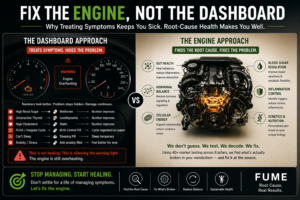
Now imagine you pull over, open the dashboard panel, and disconnect the wire going to that warning light. The light goes off. The needle drops. Problem solved, right?
Obviously not. The engine is still overheating. You have just stopped the dashboard from telling you about it. The problem has not gone away. You have just gone blind to it. And if you keep driving, the engine will seize.
Nobody would do this with their car. It sounds absurd. But this is exactly — exactly — how most of us treat our health.
Your blood sugar is high? Here is metformin to bring the number down. Your thyroid is underactive? Here is levothyroxine to push the TSH number into range. Your cholesterol is elevated? Here is a statin. PCOS? Birth control pills to regulate the cycle on paper. Can’t sleep? Sleeping pill. Anxious? Anti-anxiety medication.
Every single one of these is a dashboard fix. The warning light gets switched off. The number on the report looks better. Your doctor says “your levels are now controlled.” And everyone moves on.
But nobody asked: why did the engine overheat in the first place?
That question — the “why” question — is the entire foundation of what we do at FUME. And the refusal to ask that question is the reason millions of Indians spend years on medication, feel progressively worse, and eventually accept that “managing” a condition is the best they can hope for.
It is not. Not even close.
The Dashboard Delusion: How “Normal” Reports Hide Real Problems
Let me tell you what happens in a typical scenario. A 45-year-old operations head at a logistics company in Pune goes for his annual checkup. His company provides a standard health package — maybe 15 to 20 parameters. The basics. Complete blood count, fasting glucose, lipid profile, liver function, kidney function, TSH.
His fasting glucose comes back at 104. The reference range says under 100 is normal. His doctor says, “Slightly elevated, watch your diet.” His total cholesterol is 210 — “a bit high, reduce fried food.” His TSH is 4.2 — “borderline, let’s recheck in six months.” Everything else is “within range.”
He leaves the clinic feeling cautiously okay. Maybe he skips the samosa at lunch for a week. Maybe he goes for a morning walk for ten days. Life takes over, and he forgets about it until next year.
What nobody tested: his fasting insulin level — which, if checked, would have shown early-stage insulin resistance that fasting glucose alone cannot detect. His HOMA-IR — the gold-standard marker for insulin resistance — was never calculated because no one ordered fasting insulin. His hs-CRP — a marker of systemic inflammation that predicts cardiovascular and metabolic disease years before symptoms appear — was not on the standard panel. His triglyceride-to-HDL ratio — which research shows is a far better predictor of heart disease than total cholesterol — was never looked at because the doctor focused on total cholesterol, which is almost meaningless in isolation. His Vitamin D, B12, and ferritin — all critically linked to energy, metabolism, and thyroid function — were not included in the corporate health package.
His dashboard said he was fine. His engine was already in trouble. And nobody was looking at the engine.
Two years later, he was diagnosed with Type 2 diabetes. Three years after that, his doctor added a blood pressure medication. His wife, meanwhile, was put on thyroid medication after years of fatigue and weight gain that everyone — including her doctors — attributed to “stress and ageing.”
Two people. Two sets of “normal” reports. Two eventual diagnoses that could have been caught and potentially prevented years earlier. Not with better medication. With better testing.
This is the dashboard delusion. And it is India’s biggest healthcare blind spot.
What Does “Fixing the Engine” Actually Mean?
When we say “fix the engine” at FUME, we are not using it as a feel-good metaphor. We mean something very specific.
Your metabolism is not one thing. It is a network of interconnected biological systems — genetics, gut microbiome, hormones, glucose regulation, inflammation pathways, nutrient processing, stress response, and cellular health. These systems do not operate in silos. They talk to each other constantly. When one system goes off balance, it pulls others with it.
Insulin resistance does not happen in isolation. It is usually accompanied by — and often caused by — gut inflammation, hormonal disruption, nutrient deficiencies, and genetic predispositions that make certain metabolic pathways more vulnerable. Thyroid dysfunction does not happen in isolation either. The gut influences thyroid hormone conversion. Cortisol from chronic stress suppresses thyroid function. Nutrient deficiencies — particularly selenium, zinc, and iodine — impair thyroid hormone production.
Every condition has a web of causes underneath it. Medication addresses the end result — the dashboard reading. Root-cause health traces the web back to where it began and addresses the system failures driving the condition.
That is what fixing the engine means. Finding the actual mechanical failures — not just the warning lights they trigger.
The FUME Approach: A Client Journey From Dashboard to Engine
Let me walk you through what this looks like in practice, because the concept makes sense to most people but the process is where the real difference lies.
Step 1 — The diagnostic deep dive. When someone begins their journey with FUME, the first thing that happens is not a diet plan. It is not a workout routine. It is not a motivational speech about willpower. It is a comprehensive diagnostic assessment through our Bio-Intelligence System — 8 biological pillars that together create a complete picture of what is happening inside the body.
This includes genetic and epigenetic testing to understand how your body is wired to process nutrients, handle toxins, and manage inflammation. Gut microbiome analysis to assess the bacterial ecosystem that controls everything from fat storage to mood to thyroid conversion. A deep metabolic blood panel with 40+ markers — not the 5-marker corporate health checkup, but the real markers that reveal insulin resistance, inflammatory burden, nutrient deficiencies, and hormonal disruption years before standard tests catch them. Hormonal profiling across thyroid, adrenal, and reproductive pathways. Continuous glucose monitoring to see how your body actually responds to food in real time — not a single fasting number, but a 24-hour, 7-day picture. Body composition analysis that goes beyond the weighing scale to measure visceral fat, muscle mass, and fat distribution. Lifestyle and stress assessment covering sleep, cortisol patterns, and metabolic stress triggers. And longevity markers that evaluate biological ageing and long-term metabolic resilience.
Not every person needs every test. Our clinical team — which includes 5 to 6 functional medicine doctors led by Dr. Uma Mittal (PhD, Nutrition) — determines which pillars are most relevant based on your specific symptoms, history, and goals.
Step 2 — The root-cause map. Once the data comes in, our team does something that standard healthcare almost never does: they look at everything together. Not glucose in isolation. Not thyroid in isolation. Not gut in isolation. Everything mapped against everything else.
This is where patterns emerge that no single-system specialist would ever see. The connection between your gut dysbiosis and your rising blood sugar. The link between your genetic detox pathway variants and your chronic inflammation. The relationship between your cortisol pattern and your thyroid conversion rate. The reason your body stores fat specifically around your belly despite being otherwise lean.
These connections are not guesswork. They are data-driven insights that come from analysing multiple biological systems simultaneously.
Step 3 — The personalised protocol. Only now — after understanding what is actually happening in the engine — do we design the intervention. And “intervention” at FUME does not mean a generic diet chart with Monday-to-Sunday meals.
It means nutrition designed around your specific genetic nutrient processing profile and glucose response patterns. Gut repair protocols based on your actual microbiome data — specific strains that need support, specific strains that need to be reduced, specific foods that feed the right or wrong populations in your gut. Hormonal support through targeted nutrition, lifestyle adjustments, and supplementation based on your hormonal panel — not a one-size-fits-all approach. Lifestyle modifications that address your specific stress and sleep patterns, because cortisol management is not optional — it is metabolic medicine. And targeted supplementation for the specific nutrient gaps your testing revealed — not a multivitamin that assumes everyone is deficient in the same things.
Step 4 — Guided implementation with daily accountability. This is where most health programmes fall apart even if they get the science right. Knowing what to do and actually doing it consistently are two different things entirely. At FUME, every client in our transformation programme gets 1:1 coaching and daily accountability. Not a WhatsApp group with 200 people. Not a pre-recorded video library. A real person tracking your progress, adjusting your protocol based on how your body responds, and keeping you consistent through the inevitable difficult patches.
Step 5 — Measure, adjust, repeat. Root-cause health is not a one-time fix. As your body responds to the protocol, your markers shift — and the protocol needs to evolve with them. We re-test key markers at defined intervals to see what is improving, what needs more attention, and what can be scaled back. The engine gets tuned progressively, not fixed once and forgotten.
This five-step process — diagnose, map, design, implement, measure — is what separates root-cause health from everything else in the market. Diets skip straight to step 3 without doing steps 1 and 2. Doctors do a superficial version of step 1 and then medicate. Gym trainers start at step 4 and wonder why nothing sticks.
Why This Matters More After 35
I want to address something specific here because it is directly relevant to most people reading this.
Your body at 25 is forgiving. You can eat badly, sleep poorly, stress constantly, and skip health checkups — and your body compensates. The engine runs hot but it keeps running. The dashboard stays quiet.
After 35, that forgiveness ends. The compensatory mechanisms start failing. Insulin sensitivity declines. Hormonal production shifts. Gut diversity reduces. Inflammatory markers creep up. Muscle mass starts dropping. Recovery slows down.
This is not ageing in the inevitable, nothing-you-can-do-about-it sense. This is accumulated metabolic damage becoming visible. The engine problems that were always there — from years of processed food, sedentary work, chronic stress, poor sleep, and untested biology — finally exceed the body’s ability to compensate.
This is why the “suddenly” in health diagnoses is almost never sudden. “I was suddenly diagnosed with diabetes.” No. Your insulin resistance had been building for years — nobody tested for it. “My thyroid suddenly stopped working.” No. Your thyroid was being undermined by gut inflammation and nutrient deficiencies for years — nobody looked.
The people who avoid these “sudden” diagnoses are not genetically lucky. They are the ones who looked at the engine before the dashboard started screaming.
The Choice That Defines Your Next 20 Years
Here is the reality. You are reading this article, which means you are already thinking about your health more seriously than most people. You probably already know something is not right — even if your reports say otherwise. Maybe it is the belly fat that will not budge. Maybe it is the fatigue that coffee cannot fix anymore. Maybe it is the creeping numbers on your blood reports that your doctor dismisses as “borderline.”
You have two choices.
You can continue treating the dashboard. Take the medication. Follow the generic diet. Hope the numbers stay manageable. And accept that “controlled” is the best outcome available to you.
Or you can open the engine. Find out what is actually happening inside your body — not what a 5-marker test approximates. Understand the root causes driving your symptoms. And fix them at the source.
That is what FUME exists to do. Not better diets. Not better supplements. Better understanding. Of your genetics. Your gut. Your hormones. Your metabolism. Your biology.
Because once you understand the engine, fixing it becomes straightforward. It is the not-knowing that keeps people stuck for years.
If you are ready to stop managing your dashboard and start fixing your engine, this is where you begin:
Apply for a Root-Cause Consultation →
Fix the Engine, Not the Dashboard — How Root-Cause Health Works | Why treating symptoms is like adjusting your car’s dashboard while the engine fails. Learn how FUME’s root-cause approach uses 40+ marker testing to fix what’s actually broken in your metabolism. root cause health, root cause approach to health, root cause vs symptoms, metabolic health India, fix metabolism, why diets don’t work, FUME Bio-Intelligence System, functional medicine India, root cause diabetes thyroid PCOS
Your body is not broken. It is confused. Decode the engine, and the dashboard takes care of itself.