
Why Diets Fail After 40 — The Metabolic Shift Nobody Talks About | The diet that worked at 30 backfires at 42. Learn why your metabolism fundamentally changes after 40 and why only a root-cause, diagnostic-first approach works for lasting results. https://transform.fume.fit/fumefit-vsl-s1/
A 44-year-old CFO from Gurgaon told me something during his initial consultation that I have now heard, in some version, from hundreds of people.
“I used to be able to lose weight just by skipping dinner for two weeks. At 30, I could get back in shape in a month. Now I have been dieting for eight months and I have gained two kilos. I am eating less than I have ever eaten in my life. I am exercising more than I have in years. And my body is doing the exact opposite of what it should be doing. Either I am broken, or physics is broken. Something is not adding up.”
He was not broken. Physics was not broken. But his understanding of what was happening inside his body at 44 versus what was happening at 30 — that was completely, fundamentally wrong. And so was his approach.
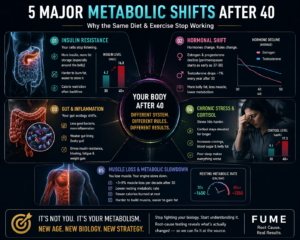
Here is the uncomfortable truth that almost nobody in the Indian health industry will tell you directly: the metabolic machinery you are operating at 40 is not the same machinery you had at 30. It is not even a slightly worn version of the same machinery. It is a fundamentally different system with different rules, different vulnerabilities, and different requirements.
And the diet strategies that worked at 30 — calorie cutting, intermittent fasting, “clean eating,” gym six days a week — are not just ineffective after 40. For many people, they are actively making things worse.
Let me explain why.
Change #1: Your Insulin Has Turned Against You
At 30, your body handled carbohydrates with relative ease. You ate rice, roti, the occasional sweet — your pancreas released insulin, glucose got shuttled into cells for energy, and life went on. The system was efficient.
By 40, that efficiency has often quietly eroded. Not because you did anything catastrophically wrong. But because years of standard Indian dietary patterns — high refined carb intake, frequent meals and snacking, sugar in chai three times a day, late dinners, irregular meal timings — have been slowly wearing down your insulin signalling system.
The result is insulin resistance. Your cells stop responding to insulin as efficiently as they used to. Your pancreas compensates by pumping out more insulin. And here is the part that changes everything about how your body handles food: elevated insulin is a fat storage hormone. When insulin stays chronically elevated, your body shifts into storage mode. It becomes biochemically harder to burn fat and biochemically easier to store it — regardless of how little you eat.
This is why calorie restriction stops working. You are eating 1,400 calories and gaining weight, and you think the laws of thermodynamics have betrayed you. They have not. Your body is simply prioritising fat storage over fat burning because your insulin environment has changed. Eating less does not fix an insulin problem. It often worsens it, because severe calorie restriction can further dysregulate blood sugar and spike cortisol — which drives even more insulin resistance.
The cruel irony: the harder you diet, the more your body resists.
A 46-year-old architect from Bangalore had been eating 1,200 calories a day for five months. She was exhausted, constantly cold, and had not lost a single kilo. When we tested her at FUME, her fasting insulin was three times the optimal level. Her HOMA-IR — the direct measure of insulin resistance — was 5.1, against a healthy level of under 1.5. Her body was swimming in insulin. Every calorie she ate was being directed to storage. And nobody — not her dietitian, not her GP, not her gym trainer — had ever tested her insulin levels. They had only tested fasting glucose, which was still “in range.”
Her dashboard was normal. Her engine was flooded.
Change #2: Your Hormones Have Rewritten the Rules
Between 35 and 50, your hormonal landscape undergoes a seismic shift. This is not news — everyone knows about menopause in women and “andropause” in men. But what most people do not realise is how directly these hormonal changes affect metabolism, fat storage, and the body’s response to diet and exercise.
For women: Oestrogen and progesterone begin fluctuating and eventually declining years before menopause actually arrives — a phase called perimenopause that can start as early as 37 or 38. These hormonal shifts do not just cause hot flashes and mood swings. Declining oestrogen directly reduces insulin sensitivity. It changes where fat gets stored — shifting it from hips and thighs to the abdomen. It affects thyroid function, sleep quality, and the gut microbiome. A woman’s body at 42 responds to the same foods and exercise completely differently than it did at 32 — not because she changed, but because her hormonal environment changed.
For men: Testosterone begins declining at roughly 1% per year after age 30. By 45, many Indian men are operating with significantly lower testosterone than their body needs for optimal metabolic function. Low testosterone does not just affect energy and libido — it directly increases visceral fat storage, reduces muscle mass (which lowers resting metabolic rate), increases insulin resistance, and impairs sleep quality. A man eating the same diet and doing the same workouts at 45 as he did at 35 will get fundamentally different results — because the hormonal engine running his metabolism has downshifted.
And here is what makes this particularly frustrating: most doctors do not test detailed hormonal panels during routine checkups. Women get a basic thyroid check. Men get nothing. The hormonal shift that is silently restructuring their entire metabolic system goes completely unexamined.
At FUME, hormonal health is Pillar 4 of our Bio-Intelligence System. We do not guess about hormones. We test thyroid function comprehensively — not just TSH, but Free T3, Free T4, thyroid antibodies. We assess cortisol patterns, reproductive hormones, and metabolic hormonal signalling. Because you cannot fix a post-40 metabolism without understanding the hormonal environment it is operating in.
Change #3: Your Gut Has Lost Its Allies
Here is something that does not get nearly enough attention: your gut microbiome — the trillions of bacteria that influence everything from fat storage to inflammation to mood — changes significantly as you age.
Research consistently shows that microbial diversity declines with age. The populations of beneficial bacteria that help regulate metabolism, reduce inflammation, and support immune function tend to shrink. Meanwhile, potentially problematic strains can proliferate, especially in the presence of chronic stress, poor sleep, frequent antibiotic use, and highly processed food — all common features of Indian professional life between 30 and 50.
A less diverse, more imbalanced gut microbiome means several things for your metabolism after 40. More systemic inflammation — which drives insulin resistance and fat storage. Impaired thyroid hormone conversion — approximately 20% of T4-to-T3 conversion happens in the gut. Reduced production of short-chain fatty acids that protect gut lining integrity and regulate appetite. Increased intestinal permeability — “leaky gut” — which triggers immune responses that further destabilise metabolic function.
So when you are 44 and eating the same “healthy” diet that worked at 34 and getting completely different results, part of the reason is that the bacterial workforce processing your food has changed. The same food is being handled by a different team — a diminished, less efficient, more inflammatory team.
A 48-year-old business owner from Ahmedabad came to us after spending two years bouncing between dietitians. He was meticulous — weighed his food, tracked macros, ate “clean.” Still gaining belly fat. Still tired. Still bloated.
When we ran his gut microbiome analysis, the picture was stark. His microbial diversity score was significantly below the healthy range. He had an overgrowth of specific inflammatory bacterial strains and a near-absence of several key anti-inflammatory species. His gut was not processing food the way a healthy gut should — and no amount of “eating right” was going to overcome that fundamental processing failure.
We repaired his gut first. Before touching his diet. Before changing his exercise. Three months of targeted microbiome restoration. Only then did we optimise his nutrition — based on his genetic data, glucose response patterns, and hormonal profile. The belly fat that two years of careful dieting could not touch started reducing within weeks of his gut reaching a healthier state.
Change #4: Your Stress Is No Longer Recoverable
At 30, you could pull an all-nighter, eat badly for a week during a project deadline, sleep four hours, and bounce back in a couple of days. Your stress response system — particularly your cortisol regulation — was resilient enough to handle acute stress without lasting metabolic damage.
At 40 or 45, that recovery capacity is significantly diminished. And this matters far more than most people realise, because cortisol is not just a “stress hormone.” It is a metabolic wrecking ball when chronically elevated.
Chronic cortisol elevation increases blood sugar — even if you are eating perfectly. It promotes visceral fat storage — specifically around the abdomen. It impairs thyroid function. It disrupts sleep architecture, which further impairs metabolic recovery. It breaks down muscle tissue — reducing the lean mass that drives your resting metabolic rate. It increases appetite and cravings — particularly for high-carb, high-sugar foods.
Most Indian professionals between 40 and 55 are operating in a state of chronic, unrelenting cortisol elevation. Work pressure, financial responsibilities, family demands, ageing parents, children’s education, commuting, inadequate sleep — the stress load is relentless, and the body’s ability to metabolically recover from it has declined.
This is why the aggressive six-day gym routine that makes a 28-year-old leaner can make a 45-year-old fatter. High-intensity exercise is a stressor. For a body that is already cortisol-saturated and under-recovered, adding more physical stress does not burn fat. It raises cortisol further, breaks down muscle, increases inflammation, and triggers compensatory fat storage.
We see this pattern constantly at FUME. A driven, disciplined professional — usually male — who is doing everything the fitness industry tells him to do and getting worse. When we assess his lifestyle stress and cortisol patterns through Pillar 7 of our Bio-Intelligence System, the picture becomes obvious. His body is not under-exercised. It is over-stressed and under-recovered. The prescription is not more effort. It is smarter recovery.
Change #5: Your Muscle Is Disappearing (And Taking Your Metabolism With It)
Starting around age 30 and accelerating after 40, the human body loses muscle mass — a process called sarcopenia. This is not just an aesthetic concern. It is a metabolic emergency that nobody treats as one.
Muscle is your body’s largest glucose disposal system. The more muscle you have, the more efficiently your body handles blood sugar. Muscle is also the primary driver of your resting metabolic rate — the number of calories your body burns at rest. When muscle mass declines, both of these systems take a hit. Blood sugar regulation weakens. Resting metabolism drops. You burn fewer calories doing literally nothing.
This creates a vicious downward spiral: less muscle → lower metabolism → easier fat gain → more insulin resistance → more fat storage → less ability to build muscle → further metabolic decline.
And here is the compounding problem: many popular diets after 40 — particularly severe calorie restriction and “clean eating” plans that are low in protein — accelerate muscle loss. You are losing weight on the scale but a significant portion of that weight is muscle, not fat. Your body composition is getting worse even as the number goes down. And when you eventually go off the diet — which everyone does — the weight comes back as fat. You are now heavier than before with less muscle. Your metabolism is slower than before. And the next diet will work even less.
This is why we measure body composition — Pillar 6 of our Bio-Intelligence System — rather than body weight. The weighing scale cannot tell the difference between losing 3 kg of fat and losing 3 kg of muscle. The difference, metabolically, is enormous.
The Post-40 Body Does Not Need a Better Diet. It Needs a Better Diagnosis.
Everything I have described above — insulin resistance, hormonal shifts, gut microbiome decline, cortisol dysregulation, muscle loss — is happening simultaneously in most Indians over 40. These five changes interact with each other, amplify each other, and create a metabolic environment that no generic diet or exercise programme can overcome.
This is not a motivation problem. This is not a discipline problem. This is a biology problem. And biology problems require biological answers.
At FUME, when someone over 40 comes to us after years of failed diets, we do not hand them another meal plan. We run the diagnostics that reveal which of these five shifts — and in what combination — is driving their specific situation. Because a 42-year-old woman whose primary driver is perimenopausal hormonal change needs a completely different intervention than a 47-year-old man whose primary driver is insulin resistance compounded by gut dysbiosis.
The answer is never the same. Because the engine failure is never the same. And that is exactly why generic solutions fail — they assume everyone’s engine is broken in the same way.
Yours is not. And until someone actually opens the hood and looks, every diet you try is a guess.
If you are over 35 and tired of guessing, start here:
Apply for a Root-Cause Consultation →
Your body is not broken. It is not even old. It is just operating with different rules now — and nobody gave you the updated manual. That is what we are here for.